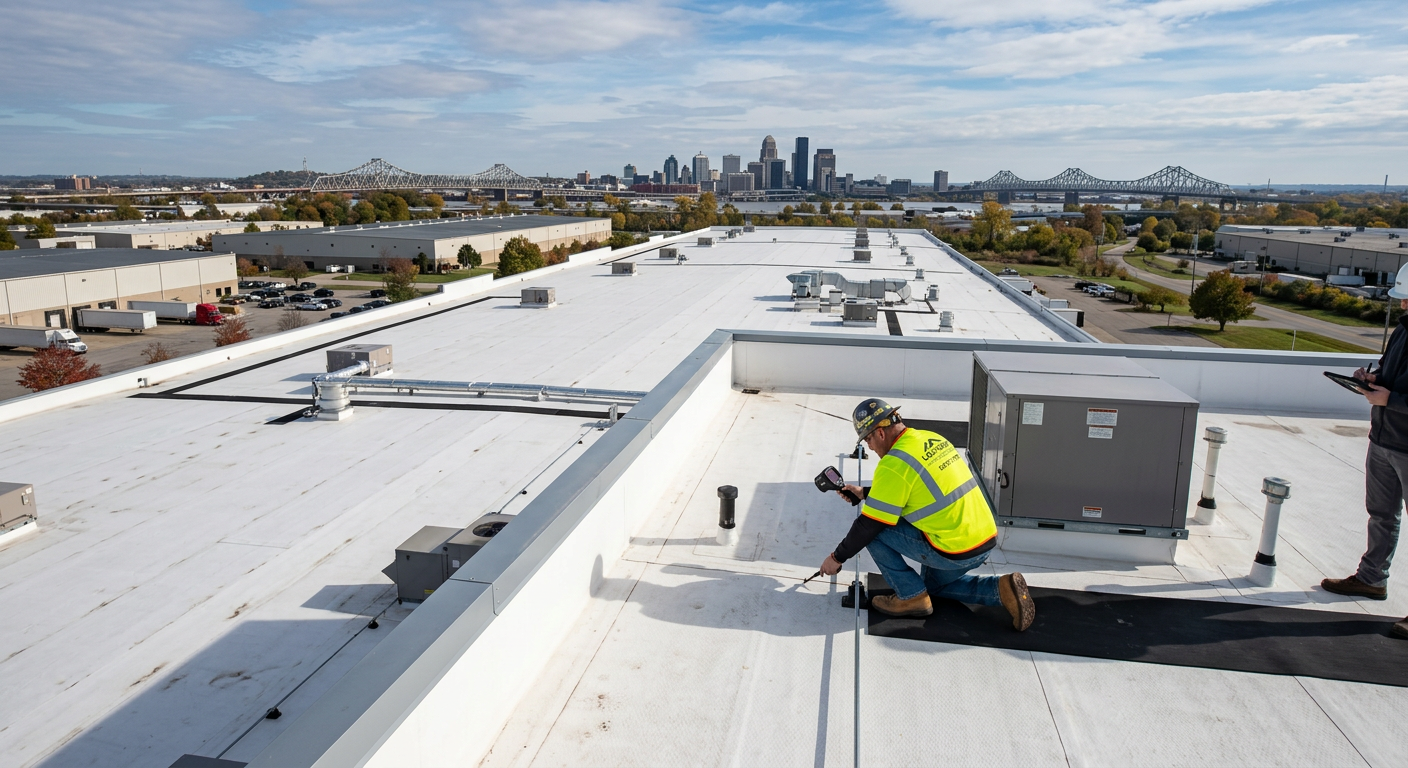
Flat and low-slope roofing systems are the standard for commercial buildings across Louisville — from the warehouse districts near the Riverport to the office parks in Jeffersontown and the retail corridors along Bardstown Road. When it's time to replace or install a flat roof, the two most common options are TPO (Thermoplastic Polyolefin) and EPDM (Ethylene Propylene Diene Monomer). Both are well-proven systems, both work well in Louisville's climate, and both have meaningful differences that affect performance, cost, and longevity.
Here's what every Louisville commercial property owner should understand before making the decision.
What Is TPO?
TPO is a single-ply membrane system installed in large white or light-colored sheets, heat-welded at the seams. It's been the fastest-growing commercial roofing membrane in North America over the past 15 years and has become the default choice for many commercial roofing projects in Louisville, KY.
TPO Advantages:
- Reflectivity. TPO's white surface reflects solar heat, reducing cooling loads — a meaningful benefit in Louisville summers where commercial buildings can absorb significant heat through a dark roof.
- Weld strength. Heat-welded seams are stronger than adhesive bonds, creating a nearly monolithic membrane when installed correctly.
- Chemical resistance. TPO resists oils, grease, and certain industrial chemicals — relevant for restaurant buildings, light manufacturing, and food distribution facilities common in Louisville's commercial districts.
- Energy efficiency. Many Louisville commercial tenants and owners qualify for energy incentives with reflective roof systems.
- Cost-competitive. TPO typically costs slightly less than EPDM on materials, making it attractive for budget-conscious projects.
TPO Limitations:
- Formulation quality varies significantly by manufacturer. Premium TPO products from established manufacturers perform very differently from budget-grade membranes.
- Requires skilled installation for proper seam welding — poor seams are the primary failure point.
- Relatively newer product (compared to EPDM's 60+ year track record), though modern TPO is highly reliable.
What Is EPDM?
EPDM is a synthetic rubber membrane that has been used on commercial roofs since the 1960s. Its durability record is unmatched, and many Louisville commercial buildings still have original EPDM roofs from the 1970s performing well today.
EPDM Advantages:
- Proven longevity. EPDM's track record is decades longer than any other commercial membrane system. A properly installed EPDM roof commonly lasts 30–50 years.
- Flexibility in cold. EPDM remains flexible in extreme cold — important in Louisville, where February temperatures can drop to single digits. This flexibility prevents cracking during freeze-thaw cycles.
- Puncture resistance. The rubber membrane is highly resistant to foot traffic and minor punctures compared to some TPO formulations.
- Simple repairs. EPDM repairs are straightforward — the same rubber tape and adhesive used in installation handles most maintenance needs.
- Established performance data. No material in commercial roofing has more long-term performance data than EPDM.
EPDM Limitations:
- Dark colored. Traditional EPDM is black, which absorbs heat — a real cost in Louisville summers. White EPDM is available but more expensive.
- Seams are adhesive-bonded, not welded, which is a potential weak point in systems that age or weren't installed with proper overlap and adhesive coverage.
- Less energy-efficient than white TPO without upgrading to white EPDM or adding a coating.
Louisville's Climate: Which Handles It Better?
Louisville's climate throws a lot at flat roofs:
- Hot, humid summers with UV exposure and potential ponding water issues
- Cold winters with freeze-thaw cycles that stress roofing materials
- Heavy spring rainfall — Louisville averages nearly 50 inches per year
- Hail and wind events from storm systems that track through the Ohio River valley
For summer performance: TPO wins on energy efficiency due to reflectivity. A white TPO roof can reduce cooling costs by 15–25% in a Louisville summer compared to a black EPDM system.
For winter performance: EPDM's flexibility gives it a slight edge in severe cold snaps, though modern TPO formulations handle Louisville winters without issue when properly installed.
For overall longevity: EPDM's track record speaks for itself, though quality TPO from reputable manufacturers now approaches comparable lifespans.
Cost Comparison for Louisville Commercial Buildings
For a mid-size commercial building (10,000–20,000 sq ft) in Louisville:
- TPO installation: $4.50–$7.50 per square foot
- EPDM installation: $4.00–$7.00 per square foot
The difference is typically modest. Where costs diverge is in long-term maintenance and energy performance — factors that favor the material best suited to your specific building use.
Which Should You Choose?
Choose TPO if:
- Energy costs are significant for your building
- You want a reflective roof and potential utility incentives
- Your building involves commercial kitchen exhaust or chemical exposure
Choose EPDM if:
- Longevity is your top priority
- You want the most proven track record in the industry
- Your budget favors a material with exceptional repair simplicity
Both systems are excellent choices for commercial roofing in Louisville, KY when installed by an experienced contractor who understands flat roof drainage, tapered insulation, and seam integrity.
---
Louisville Roofing & Siding specializes in commercial roofing in Louisville, KY — TPO, EPDM, and fluid-applied systems for flat and low-slope structures across Jefferson County and the surrounding region. Call (502) 416-1707) to discuss your commercial roof project with our team.
Need Help With Your Roof or Siding?
Louisville Roofing & Siding offers free estimates with no pressure. Call us today.