Active leak? Storm tore your roof? Louisville Roofing & Siding responds 24/7 with same-day emergency tarping to stop water from destroying your home.
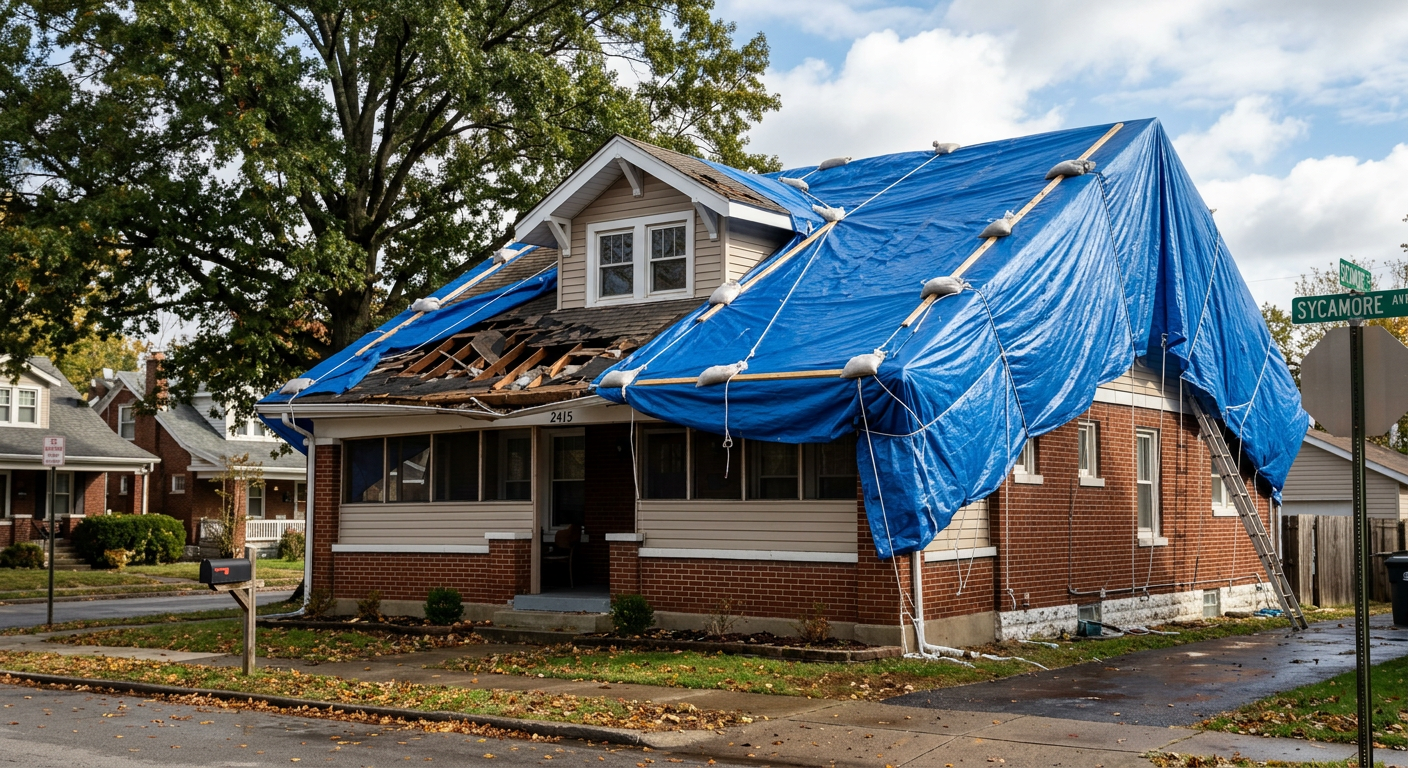
When a storm punches through your roof at midnight, you need someone who picks up the phone and shows up fast. Louisville Roofing & Siding provides 24/7 emergency response throughout the Louisville metro — and we carry tarping materials on every truck so we can secure your home the moment we arrive.
Emergency tarping is not a permanent repair — it's the critical first step that stops water intrusion, protects your interior and belongings, and preserves evidence of damage for your insurance claim.
Every minute a breach is open, water penetrates deeper — through decking, insulation, drywall, and into your living space.
Mold can begin growing within 24–48 hours of moisture intrusion. Tarping immediately dramatically reduces mold risk.
Tarping documents the damage in its original state — critical for maximizing your insurance claim before further deterioration.
Prolonged water exposure weakens roof decking, rafters, and ceiling joists. Fast tarping limits structural damage.
Louisville Roofing & Siding — 24/7 emergency response throughout Louisville and surrounding counties.
The clearest sign you need emergency tarping is visible sky where there shouldn't be any — a puncture, a section of blown-off shingles, or structural failure after a tree impact. But damage isn't always that obvious. After any major storm, if you notice new water stains on interior ceilings, hear dripping inside the walls, or find insulation wet in the attic, those are signs that water is getting in even if the breach isn't visible from the street.
Don't wait to see how bad it is. Water moves fast inside a roof system. Once it breaches the sheathing, it migrates horizontally along framing members and insulation before it shows up as a ceiling stain. By the time you see visible water damage indoors, it's likely already been sitting in the structure for hours. Mold begins forming within 24 to 48 hours of sustained moisture contact. A tarp installed the same day as the storm can prevent all of that.
The situations that most commonly require emergency tarping are: hail or wind damage that removes or lifts a large section of shingles, a fallen tree or large limb that punctures the decking, fire damage that burns through the roof structure, and ice dam failures that allow water backup under the shingles at the eave.
When we arrive, the first step is a quick visual assessment — from the ground with binoculars if needed, then from the roof if conditions are safe. We identify every area of active breach, including secondary vulnerabilities that may not be obvious but could fail further under ongoing rain or wind.
Professional tarping uses heavy-duty polyethylene tarps — typically 6 mil or heavier — that are cut to overlap each breach by several feet in every direction. The tarp is secured using wood battens or cap strips nailed through the tarp into the roof decking along its perimeter. This method prevents the tarp from lifting or shifting in wind, which is the failure point for DIY tarps that are simply draped and tied. We avoid nailing through the peak whenever possible to prevent the tarp from acting as a funnel and directing water toward the ridge.
Throughout the process we document the damage with photographs — the roof before tarping, the extent of visible damage, the tarp placement and coverage area. This documentation goes to you and is formatted to support an insurance claim. Adjusters want to see the damage in its original state, and our job site photos provide exactly that before any emergency remediation changes the condition.
Your homeowner's insurance policy almost certainly covers emergency tarping as part of a storm damage claim. The cost of the tarp is typically reimbursable under the same claim as the permanent repair. That said, documentation is everything. Keep a record of the time of the storm, take your own photos from the ground before we arrive, and save any weather alerts or NWS reports from that date. Those details strengthen your claim timeline.
After the tarp is in place, Louisville Roofing & Siding schedules a full damage inspection at a time that works for you. We provide a written assessment of all damage, a repair or replacement estimate, and guidance on how to file your claim. We work directly with insurance adjusters and can be on-site during the adjuster's visit if needed.
If you have active damage right now or want to make sure your roof is properly secured before the next round of weather, call us at (502) 416-1707. We operate 24 hours a day, seven days a week, and we respond fast because we know that every hour matters.